




Japanese whiskey: why it's so special
Japan's drinking culture has many facets, but many are probably only familiar with the traditional drink sake. The country produces many foreign spirits itself and creates unique styles. We introduce you to Japanese whisky.
When you think of whisky, you probably immediately have the famous Scotch, the American bourbon or a whiskey from Ireland in mind. These countries are world famous for their whiskeys, but what about Japan? Isn't the land of the rising sun better known for alcoholic beverages like sake? Not even close.
In recent years, Japanese whiskeys have become the most coveted in the world and make the hearts of whiskey fans beat faster. The problem: The rush for Japanese whiskeys came so quickly that the distilleries couldn't cope with the demand and prices exploded. But why are Japanese whiskeys so special and what led to this?
History of Japanese whiskeys
To understand what makes Japanese whiskeys so special, you have to look to the past. Two names that keep coming up in connection with whiskeys from Japan are Taketsuru Masataka and Torii Shinjirō. They are two of the main figures who have had a strong influence on Japanese whiskey and whose companies and distilleries still dominate the market today. The exciting thing about the story, however, is how the paths of the two crossed in the past.
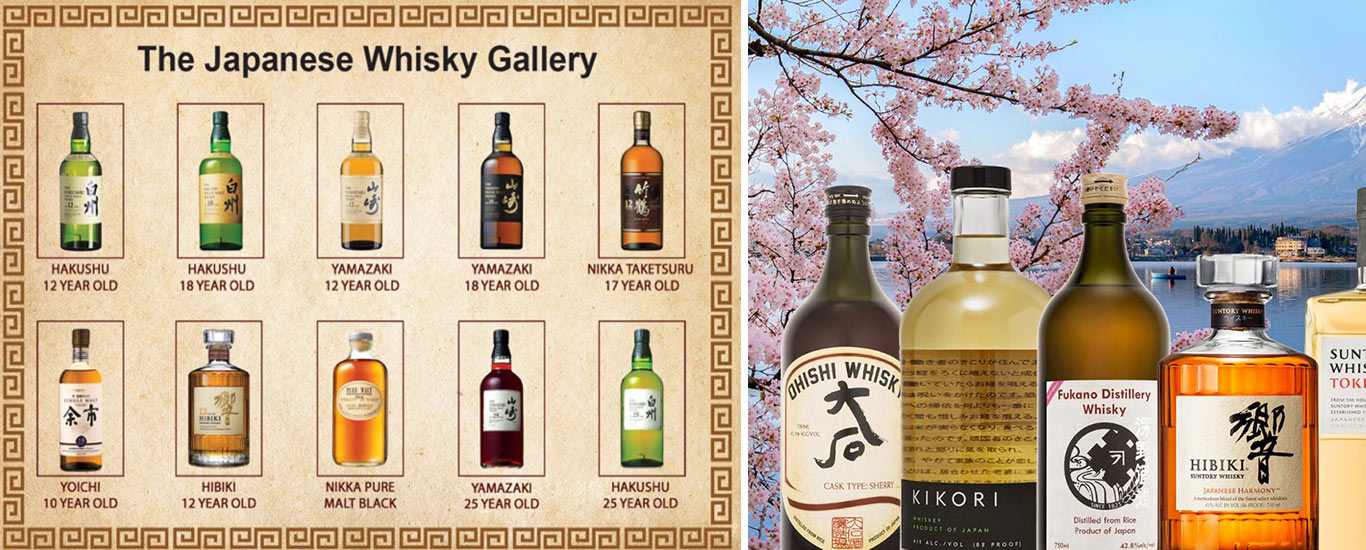
Torii Shinjirō is the founder of the world-renowned spirits manufacturer Suntory. Founded in 1899 under the name Kotobukiya, Suntory is now one of the global market leaders in the whiskey segment. The company not only unites the well-known Japanese distilleries Yamazaki, Hakushu and Hibiki under one roof, but now also owns many Scottish distilleries. Torii Shinjirō was one of the first who wanted to produce Japanese whiskey based on the Scottish model.
Born in 1894, Taketsuru Masataka is considered one of the defining characters in Japanese whiskey culture. It was he who traveled to Scotland at a young age to study in Glasgow and learn the art of whiskey making. He stopped at various distilleries and learned the craft from scratch first-hand. As it was bound to happen, Taketsuru also met his future wife Rita, a Scottish woman, there. With the enormous knowledge about the production of Scottish whiskeys in his luggage, he returned to Japan. There he began his career at Kotobukiya, the company of Torii Shinjirō. With Taketsuru Masataka he found the right person who could make his dream of Japanese whiskey come true in a Scottish style.
After Taketsuru was responsible for the development of distilleries like Yamazaki, however, disagreements arose between the founder Torii Shinjirō and him. This was the reason why he left the company and founded Nikka, the second big player in the Japanese whiskey market. The well-known distilleries Yoichi and Miyagikyo, with which Taketsuru Masataka realized his dream, are still under the umbrella of Nikka. It was these two people who brought the high-quality Scottish whiskey culture to Japan and established it there.
What makes Japanese whiskeys special?
Where the Scots work in a more strictly traditional way, the Japanese know how to combine the traditional process of Scottish whiskey production with new technologies and to develop their own style. They don't change the traditional way, but monitor and tweak it to perfection to create the optimal product. When choosing their raw materials (barley and water), they pay meticulous attention to quality.
In addition to the use of technology, the Japanese are also masters in so-called “blending”. When blending whiskey, different matured whiskey casks are “married”, i.e. mixed. Each cask has unique aromas due to the different maturation periods and properties. The so-called "master blender" knows how to combine the right aromas of the whiskeys and thus to design the end result with targeted blending according to his ideas. This technique is perfectly mastered by the Japanese whiskey producers.
In addition to the production, Japanese whiskey is characterized by a different flavor profile compared to the Scots. It tends to be smoother and more subtle than Scotch whiskeys and tends to have a lower alcohol content. It's not that the distilleries don't also bottle excellent cask strength whiskeys with high alcohol content, but mostly Japanese people drink their whiskey during or after the meal, which is why the spirit should not dominate the taste of the meal. This is also the reason why the Japanese work less with peated barley and rarely produce smoky whiskey. However, there are also exceptions, such as the Hakushu or Yoichi distilleries,
As previously mentioned, the Japanese don't just bottle low-alcohol whiskeys. One distillery stands out here with its regular series. The Chichibu Distillery is located in the city of Chichibu (Saitama Prefecture) and was only founded in 2008. Although it is still very young and small in comparison, it is famous for its single cask bottlings , which are always of very high quality and are usually completely sold out within a few minutes, often at prices in excess of 1,000 euros. This small distillery is also an example of the high quality of Japanese whiskies.
How Japanese whiskey fought its way to the top
Until the beginning of 2015, Japanese whiskeys led a rather shadowy existence. Although they received their first awards in 2007, relatively little attention was paid to them. However, this changed abruptly when Jim Murray, probably the most famous whiskey expert in the world, voted the Japanese Yamazaki Sherry Cask from 2013 the best single malt whiskey in the world in his annual "Whisky Bible". From then on everything was to change and the rush for Japanese single malt whiskeys began. The success was to be followed by many more awards, fueling demand even further.
However, this still causes major problems today, because in the past the distilleries had stored and matured too little whiskey to be able to meet the demand. The high demand and the low supply led to an extreme price increase. One of many examples is the Yamazaki 18 years old, which was initially available for 70 euros, but now has a price of 500 euros. Nevertheless, the majority of Japanese whiskeys have not only developed into luxury whiskeys: Many of the bottlings even had to be discontinued due to empty warehouses, which drove up demand and prices even further. The so-called "age statement" whiskeys, i.e. whiskeys with an age statement, are particularly affected.
Japanese whiskey is not always Japanese whisky
If you want to try real Japanese whiskey, you should do some research in advance. Japanese distilleries have far fewer guidelines than Scottish distilleries, which is why the whiskey only has to be bottled in Japan to be declared as "Japanese whisky". Due to high demand and low supply, some distilleries have taken to importing whiskey from Scotland and blending it with theirs.
Japanischer Whisky: Weshalb er so besonders ist
Japans Trinkkultur besitzt viele Facetten, doch vielen ist wohl nur das traditionelle Getränk Sake ein Begriff. Dabei produziert das Land viele ausländliche Spirituosen selbst und kreiert dabei einzigartige Stile. Wir stellen Ihnen den japanischen Whisky vor.
Wer an Whisky denkt, der hat vermutlich sofort den berühmten Scotch, den amerikanischen Bourbon oder einen Whiskey aus Irland im Kopf. Diese Länder sind weltweit berühmt für ihre Whiskys, doch wie sieht das mit Japan aus? Ist das Land der aufgehenden Sonne nicht eher bekannt für alkoholische Getränke wie Sake? Weit gefehlt.
In den letzten Jahren haben sich japanische Whiskys zu den begehrtesten der Welt entwickelt und lassen Herzen von Whisky-Fans höher schlagen. Das Problem: Der Ansturm auf japanische Whiskys kam so schnell, dass die Destillerien mit der Nachfrage nicht zurechtkommen und die Preise geradezu explodieren. Aber wieso sind japanische Whiskys so besonders und was hat dazu geführt?
Geschichte japanischer Whiskys
Um zu verstehen, was japanische Whiskys so besonders macht, muss man einen Blick auf die Vergangenheit werfen. Zwei Namen, die in Verbindung mit Whiskys aus Japan immer wieder fallen, sind Taketsuru Masataka und Torii Shinjirō. Sie sind zwei der Hauptfiguren, die japanischen Whisky stark geprägt haben und deren Firmen beziehungsweise Destillerien noch heute den Markt dominieren. Das Spannende an der Geschichte ist allerdings,wie sich die Wege der beiden in der Vergangenheit gekreuzt haben.
Torii Shinjirō ist der Gründer des weltweit bekannten Spirituosenherstellers Suntory. Im Jahr 1899, noch unter dem Namen Kotobukiya gegründet, ist Suntory heute einer der weltweiten Marktführer im Whisky-Segment. Dabei vereint das Unternehmen nicht nur die bekanntesten japanischen Destillerien Yamazaki, Hakushu und Hibiki unter einem Dach, sondern ist mittlerweile auch im Besitz vieler schottischer Destillerien. Torii Shinjirō war einer der ersten, der japanischen Whisky nach schottischem Vorbild produzieren wollte.
Der 1894 geborene Taketsuru Masataka gilt als einer der prägenden Charaktere in der japanischen Whisky-Kultur. Er war es, der in noch jungen Jahren nach Schottland reiste, um in Glasgow zu studieren und die Kunst der Whiskyherstellung zu erlernen. Dabei machte er Halt an unterschiedlichen Destillerien und erlernte das Handwerk von Grund auf aus erster Hand. Wie es kommen musste, lernte Taketsuru dort auch seine zukünftige Frau Rita, eine Schottin, kennen. Mit dem enormen Wissen rund um die Herstellung schottischer Whiskys im Gepäck kehrte er zurück nach Japan. Dort begann er seine Karriere bei Kotobukiya, dem Unternehmen von Torii Shinjirō. Mit Taketsuru Masataka fand er den Richtigen, der seinen Traum vom japanischen Whisky nach schottischer Art wahr werden lassen konnte.
Nachdem Taketsuru für den Aufbau von Destillerien wie Yamazaki verantwortlich war, ergaben sich allerdings Unstimmigkeiten zwischen dem Gründer Torii Shinjirō und ihm. Dies war der Grund, weshalb er das Unternehmen verließ und Nikka, den zweiten Big Player im japanischen Whiskymarkt, gründete. Unter dem Dach von Nikka befinden sich noch heute die bekannten Destillerien Yoichi und Miyagikyo, mit denen sich Taketsuru Masataka seinen Traum verwirklichte. Diese zwei Personen waren es, die die hochwertige Art der schottischen Whisky-Kultur nach Japan brachten und dort etablierten.
Was macht japanische Whiskys aus?
Wo die Schotten eher strikt traditionell arbeiten, verstehen es die Japaner, das althergebrachte Verfahren der schottischen Whiskyherstellung mit neuen Technologien zu verbinden und ihren eigenen Stil zu entwickeln. Sie verändern die althergebrachte Art nicht, sondern überwachen und optimieren sie bis zur Perfektion, um das optimale Produkt herzustellen. Dabei achten sie auch bei der Wahl ihrer Grundstoffe (Gerste und Wasser) penibel auf die Qualität.
Neben dem Einsatz von Technologien sind die Japaner auch Meister im sogenannten “Blending”. Beim Blending von Whisky werden verschieden gereifte Whisky-Fässer miteinander „vermählt“, also gemischt. Jedes Fass weist durch unterschiedlich lange Reifung sowie Eigenschaften einzigartige Aromen auf. Der sogenannte „Master Blender“ versteht es, die passenden Aromen der Whiskys zu kombinieren und somit das Endergebnis mit gezieltem Blending nach seinen Vorstellungen zu designen. Diese Technik beherrschen die japanischen Whisky-Hersteller perfekt.
Neben der Herstellung zeichnet sich japanischer Whisky im Vergleich zu den Schotten durch ein anderes Geschmacksprofil aus. Er ist tendenziell sanfter und subtiler als schottische Whiskys und weist meist einen geringeren Alkoholgehalt auf. Nicht, dass die Destillerien nicht auch ausgezeichnete Fassstärke-Whiskys mit hohem Alkoholgehalt abfüllen, doch meist trinken Japaner ihren Whisky während oder nach dem Essen, weshalb die Spirituose den Geschmack des Essens nicht dominieren soll. Das ist auch der Grund, weshalb die Japaner weniger mit getorfter Gerste arbeiten und rauchigen Whisky eher selten produzieren. Es gibt hierbei allerdings auch Ausnahmen, wie beispielsweise die Destillerien Hakushu oder Yoichi, die zum Großteil rauchigen Whisky herstellen – wobei auch diese meistens nicht an die Intensität eines Whiskys von der schottischen Insel Islay herankommen.
Wie bereits erwähnt, füllen Japaner nicht nur Whiskys mit geringem Alkoholgehalt ab. Eine Destillerie sticht hier mit ihren regelmäßigen Serien besonders heraus. Die Chichibu Brennerei befindet sich in der gleichnamigen Stadt Chichibu (Präfektur Saitama) und wurde erst 2008 gegründet. Obwohl sie im Verhältnis noch sehr jung und klein ist, ist sie berühmt für ihre Einzelfassabfüllungen, die stets eine sehr hohe Qualität aufweisen und meist innerhalb weniger Minuten, nicht selten zu Preisen jenseits der 1.000 Euro restlos ausverkauft sind. Auch diese kleine Destillerie ist ein Beispiel für die hohe Qualität japanischer Whiskys.
Wie sich japanischer Whisky an die Spitze kämpfte
Bis Anfang 2015 fristeten japanische Whiskys eher ein Schattendasein. Obwohl sie bereits 2007 erste Auszeichnungen erhielten, wurde ihnen noch relativ wenig Aufmerksamkeit geschenkt. Dies änderte sich allerdings schlagartig, als Jim Murray, der wohl berühmteste Whisky-Experte der Welt, in seiner jährlich erscheinenden „Whisky Bible“ den japanischen Yamazaki Sherry Cask aus dem Jahr 2013 zum besten Single Malt Whisky der Welt kürte. Fortan sollte sich alles ändern und es begann der Ansturm auf japanische Single Malt Whiskys. Auf den Erfolg sollten viele weitere Auszeichnungen folgen, die die Nachfrage noch weiter anheizten.
Dies sorgt allerdings bis heute für große Probleme, denn die Destillerien hatten in der Vergangenheit zu wenig Whisky zurückgelegt und reifen lassen, als dass sie der Nachfrage entsprechen konnten. Die hohe Nachfrage und das geringe Angebot führten zu einem extremen Preisanstieg. Eines von vielen Beispielen ist der Yamazaki 18 Jahre, welcher anfangs noch für 70 Euro zu kaufen war, heute jedoch einen Preis von 500 Euro erreicht. Dennoch hat sich der Großteil der japanischen Whiskys nicht nur zum Luxus-Whisky entwickelt: Viele der Abfüllungen mussten aufgrund der leeren Lager sogar eingestellt werden, was die Nachfrage und den Preis noch weiter in die Höhe trieb. Gerade die sogenannten „Age-Statement“-Whiskys, also Whiskys mit Altersangabe, sind davon betroffen.
Japanischer Whisky ist nicht immer japanischer Whisky
Wer echten japanischen Whisky probieren möchte, der sollte im Vorfeld etwas recherchieren. Die japanischen Brennereien haben weit weniger Richtlinien als schottische, weshalb der Whisky lediglich in Japan abgefüllt werden muss, um diesen als “japanischen Whisky” zu deklarieren. Aufgrund der hohen Nachfrage und des geringen Angebots sind einige Destillerien dazu übergegangen, Whisky aus Schottland zu importieren und diesen mit ihrem zu mischen.