



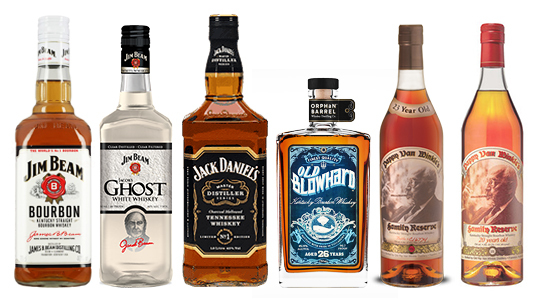
You all know American whiskey from the supermarket. But the whiskeys that we would like to present to you here are as far removed from these supermarket whiskeys as Glenfarclas or Lagavulin are from blended Scotch. They are all something special and should be enjoyed neat (no cola, no ice) or with some still water . There are two regions on the North American continent where whiskey is traditionally distilled: the area on the Saint Lawrence River in Canada and the US states of Kentucky and Tennessee.
This article is about the different types of whiskey in America and what makes them different - also according to the law.
Bourbon
Probably the best-known American whiskey variety is Bourbon, which is named after Bourbon County in Kentucky. This county got its name in honor of the French royal family, since Louis XVI helped the Americans during the wars of independence against England. By law, bourbon whiskey must be made from at least 51% corn, which gives it its typically sweet taste. The remaining grains used are rye, which is very flavorful, mild wheat and barley, which is essential for the fermentation process. American whiskey is distilled primarily in column stills. By American law, bourbon must be aged in fresh, burned-out oak barrels.
The alcohol content of bourbon must not exceed 80% when distilled and must not exceed 62.5% at the beginning of maturity. Bourbon is bottled with at least 40%, since spirits with a lower alcohol content may not be declared as whiskey or whiskey. Theoretically, bourbon can come from anywhere in the US, but most bourbon distilleries are found in the US state of Kentucky.
The mid-20th century was not a good time for whiskey makers in the United States. In the 1960s, US connoisseurs became more attracted to lighter spirits, such as gin, vodka, or imported whiskeys that were distilled to a higher alcohol strength and aged in used casks. As Americans moved away from domestic whiskey, the government responded in 1968 with a new legal category of whiskey: light whiskey. Accordingly, 'Light Whiskey' is made in the United States at more than 80% and stored in used or uncharred new oak casks.
Bourbon - Kentucky Straight Bourbon
There are other subtleties and specifications for the designation of bourbon whiskey. As already described, a bourbon consists of at least 51% corn, is stored in freshly charred oak barrels and has at least 40% alcohol content. If, in addition, the bourbon has matured for at least 2 years and is not blended after aging in the cask, it can be called 'Straight Bourbon'.
If a bourbon is produced in a single distillery during the manufacturing season, matures for at least four years in a bonded warehouse, and is bottled at more than 100 proofs (=50%), it may carry the quality designation 'Bottled in Bond' .
Kentucky Straight Bourbon may only be labeled as bourbon that was distilled in the US state of Kentucky and aged there for at least one year. An excellent representative of the Kentucky Straight Borbons is the Woodford Reserve.
Tennessee Whiskey
Tennessee Sour Mash Whiskey is growing in popularity today. As the name suggests, Tennessee Whiskey is the whiskey produced in the US state of Tennessee. Otherwise it is subject to the same requirements as bourbon whiskey . In addition, two steps in the manufacturing process characterize Tennessee Whiskey : Charcoal Mellowing and the so-called 'Sour Mash' process. The first is the filtering of the raw spirit before it is stored in the cask through a layer of activated carbon several meters thick (charcoal). The charcoal is made from the sugar maple, which is widespread in the USA . By filtering, theWhiskey really nice and soft (mellow). In the sour mash process, residues from the distillation process (stillage) are collected and added to the mash again before fermentation . This benefits the taste of the whiskey , but also the production process: adding the stillage changes the pH value of the mash. The mixture becomes more acidic so that the yeast can work optimally. This process is now used by almost every distillery in America. Thus, most bourbons are usually made with this process. So every Tennessee whiskey is also a bourbon, but not every bourbon is also a Tennessee whiskey.
Far more important for Tennessee Whiskey , however, is the fact that the whiskey is filtered through a layer of activated carbon several meters thick before it is stored. The filtering process lasts up to ten days and completely removes all turbid and suspended matter from the distillate. The resulting whiskey tastes extraordinarily soft and mild. An outstanding representative of this type of whiskey is George Dickel No. 12. America's best-selling whiskey , Jack Daniel's, is also a Tennessee whiskey .
Rye
If at least 51% rye is used in a whiskey , it can be called ' Rye Whiskey '. Rye whiskey must also be matured in oak casks. There used to be a wide variety of rye whiskeys in America . They are characterized by an exceptionally spicy taste . However, people's tastes changed over the centuries, so that rye whiskey was almost forgotten. Because today 'mild and mellow' has become fashionable. US Rye Whiskeysare rarely found today, while much of it is still produced in Canada. Because Canadian rye whiskey is an important part of Canadian blended whiskeys .
Corn Whiskey
Whiskeys with 80% corn content from the USA are called ' Corn Whiskey '. They taste very neutral. Pure corn whiskeys are therefore enjoyed very little and are mainly used for the production of blends.
A Specialty - Maple Whiskey (Maple Whiskey)
The so-called maple whiskey , in German maple whiskey , combines two things that are very characteristic of American culture: whiskey and maple syrup. Because casks are often used for maturation in the production of maple syrup , more precisely bourbon casks . Some particularly high-quality maple syrups are stored in bourbon casks and thus absorb the typical bourbon flavors. The syrups are stored in bourbon barrels for up to three months, giving them a ' finish ', so to speak. After the flavors of the two liquids harmonized so well, the makers of American whiskey came alongalso came up with the idea of turning the tables and refilling the casks from the maple syrup storage with whiskey in order to complement the whiskey with the maple syrup aromas. For example, there is Maple Whiskey with Hudson Rye Whiskey from Tuthilltown Distillery, with Bourbon from Taconic Distillery and with Cask Proof Roundstone Rye from Catoctin Creek Distillery .
Amerikanischen Whiskey aus dem Supermarkt kennen Sie alle. Doch die Whiskeys, die wir Ihnen hier vorstellen möchten, sind von diesen Supermarkt Whiskeys soweit entfernt, wie Glenfarclas oder Lagavulin vom Blended Scotch. Sie sind alle etwas Besonderes und sollten pur (ohne Cola, ohne Eis) oder mit etwas stillem Wasser genossen werden. Auf dem nordamerikanischen Kontinent existieren zwei Regionen, in denen Whiskey traditionell gebrannt wird: Die Gegend am Sankt-Lorenz-Strom in Kanada sowie die US-Staaten Kentucky und Tennessee.
In diesem Artikel geht es um die verschiedenen Whiskey-Sorten in Amerika und was sie - auch laut Gesetz - ausmacht.
Bourbon
Die wohl bekannteste amerikanische Whiskey-Sorte ist der Bourbon, der nach dem Bourbon County in Kentucky benannt ist. Dieses County bekam seinen Namen zu Ehren der französischen Königsfamilie, da Ludwig der XVI den Amerikanern während der Unabhängigkeitskriege gegen England half. Laut Gesetz muss Bourbon Whiskey zu mindestens 51% aus Mais hergestellt sein, was ihm seinen typisch süßlichen Geschmack gibt. Die restlichen verwendeten Getreidesorten sind Roggen, der sehr würzig ist, milder Weizen und Gerste, die für den Fermentationsprozess unbedingt notwendig ist. Gebrannt wird amerikanischer Whiskey hauptsächlich in Column Stills. Nach amerikanischem Gesetz muss Bourbon in frischen, ausgebrannten Eichenfässern reifen.
Der Alkoholgehalt von Bourbon darf beim Brennen 80% nicht übersteigen und zu Beginn der Reife nicht mehr als 62,5% betragen. Abgefüllt wird Bourbon mit mindestens 40%, da Brände mit niedrigerem Alkoholgehalt nicht als Whisky beziehungsweise Whiskey deklariert werden dürfen. Theoretisch kann Bourbon aus den gesamten USA kommen, jedoch finden sich die meisten Bourbon-Brennereien im US-Staat Kentucky.
Mitte des 20. Jahrhunderts war keine gute Zeit für Whiskeyhersteller in den USA. In den 1960ern kamen die US-Genießer mehr auf den Geschmack von leichteren Bränden, also Gin, Wodka oder importierten Whiskeys, die zu einem höheren Alkoholgehalt destilliert wurden und in gebrauchten Fässern gelagert wurden. Da die Amerikaner sich vom heimischen Whiskey entfernten, reagierte die Regierung 1968 mit einer neuen gesetzlichen Whiskey-Kategorie: Light Whiskey. Demnach wird 'Light Whiskey' in den Vereinigten Staaten mit mehr als 80% hergestellt und in gebrauchten oder nicht ausgekohlten neuen Eichenbehältern gelagert.
Bourbon - Kentucky Straight Bourbon
Es gibt noch weitere Feinheiten und Vorgaben zu der Bezeichnung von Bourbon Whiskey. Wie bereits beschrieben, besteht ein Bourbon zu mindestens 51% aus Mais, wird in frisch ausgekohlten Eichenfässern gelagert und hat mindestens 40% Alkoholgehalt. Wenn zusätzlich die Reifezeit des Bourbon mindestens 2 Jahre beträgt und er nach der Fasslagerung nicht verschnitten wird, so darf er sich 'Straight Bourbon' nennen.
Wird ein Bourbon in einer einzelnen Destillerie während der Herstellungssaison produziert, reift mindestens vier Jahre in einem Lagerhaus, das unter Zollverschluss steht, und wird mit mehr als 100 Proof (=50%) abgefüllt, so darf er die Qualitätsbezeichnung 'Bottled in Bond' tragen.
Kentucky Straight Bourbon darf nur der Bourbon etikettiert werden, der im US-Bundesstaat Kentucky gebrannt und mindestens ein Jahr dort gereift wurde. Ein ausgezeichneter Vertreter der Kentucky Straight Borbons ist der Woodford Reserve.
Tennessee Whiskey
Tennessee Sour Mash Whiskey erfreut sich heute einer wachsenden Beliebtheit. Wie der Name verrät, wird Tennessee Whiskey der Whiskey genannt, der im US-Staat Tennessee produziert wird. Ansonsten unterliegt er denselben Anforderungen wie Bourbon Whiskey. Zusätzlich zeichnen zwei Schritte im Herstellungsprozess den Tennessee Whiskey aus: Das Charcoal Mellowing sowie das sogenannte 'Sour Mash' Verfahren. Ersteres ist die Filterung des Rohbrandes vor der Fasslagerung durch eine mehrere Meter dicke Aktivkohleschicht (charcoal). Die Kohle wird aus dem in den USA weit verbreiteten Zuckerahorn (Sugar Maple) hergestellt. Durch die Filterung wird der Whiskey richtig schön weich (mellow). Beim Sour Mash Verfahren werden Rückstände des Brennvorganges (Stillage) gesammelt und vor der Gärung erneut zur Maische gegeben. Dies kommt dem Geschmack des Whiskeys zugute, aber auch dem Produktionsablauf: Durch hinzufügen der Stillage verändert sich der pH-Wert der Maische. Das Gemisch wird saurer, sodass die Hefe optimal arbeiten kann. Mittlerweile wird dieses Verfahren von fast allen Brennereien in Amerika angewendet. Somit sind in der Regel auch die meisten Bourbons mit diesem Verfahren hergestellt. Jeder Tennessee Whiskey ist also auch ein Bourbon, aber nicht jeder Bourbon auch ein Tennessee Whiskey.
Weitaus bedeutender für den Tennessee Whiskey ist jedoch die Filterung des Whiskeys vor der Lagerung durch eine mehrere Meter dicke Aktivkohleschicht. Der Filtervorgang dauert bis zu zehn Tage und entfernt restlos alle Trub- und Schwebstoffe aus dem Destillat. Der resultierende Whiskey schmeckt dadurch außergewöhnlich weich und mild. Ein herausragender Vertreter dieser Art von Whiskeys ist George Dickel No. 12. Der meistverkaufte Whiskey der USA, Jack Daniel's, ist ebenfalls ein Tennessee Whiskey.
Rye
Wird zu mindestens 51% Roggen in einem Whiskey verwendet, so darf er sich 'Rye Whiskey' nennen. Auch Rye Whiskey muss in Eichenfässern gereift werden. Früher gab es in Amerika eine große Auswahl an Rye Whiskeys. Ein außergewöhnlich würziger Geschmack zeichnet sie aus. Der Geschmack der Menschen wandelte sich jedoch über die Jahrhunderte, so dass der Rye Whiskey beinahe in Vergessenheit geriet. Denn heute ist 'mild and mellow' Mode geworden. US Rye Whiskeys sind heute nur noch selten zu finden, während in Kanada hingegen noch viel davon produziert wird. Denn Kanadischer Rye Whisky ist ein wichtiger Bestandteil der kanadischen Blended Whiskys.
Corn Whiskey
Whiskeys mit 80% Maisanteil aus den USA werden als 'Corn Whiskey' bezeichnet. Sie schmecken sehr neutral. Reine Corn Whiskeys werden deswegen sehr wenig genossen und vorwiegend für die Erzeugung von Blends verwendet.
Eine Besonderheit - Maple Whiskey (Ahorn Whiskey)
Der sogenannte Maple Whiskey, auf Deutsch Ahorn Whiskey, vereint zwei für die amerikanische Kultur sehr auszeichnende Dinge: Whiskey und Ahornsirup. Denn auch in der Herstellung von Ahornsirup werden oft Fässer zur Reifung verwendet, genauer gesagt Bourbonfässer. Manche besonders hochwertige Ahornsirupe werden in Bourbonfässern gelagert, und nehmen dadurch die typischen Bourbon-Geschmacksnoten auf. Bis zu drei Monate lagern die Sirupe in Bourbonfässern, erhalten sozusagen ein 'Finish'. Nachdem die Aromen der beiden Flüssigkeiten so gut miteinander harmonieren, kamen die Hersteller von amerikanischem Whiskey auch auf die Idee den Spieß umzudrehen und die Fässer aus der Ahornsirup-Lagerung wiederum mit Whiskey zu befüllen, um den Whiskey mit den Ahornsirup-Aromen zu ergänzen. So gibt es etwa Maple Whiskey mit Hudson Rye Whiskey aus der Tuthilltown Distillery, mit Bourbon aus der Taconic Distillery und mit dem Cask Proof Roundstone Rye aus der Catoctin Creek Brennerei.